
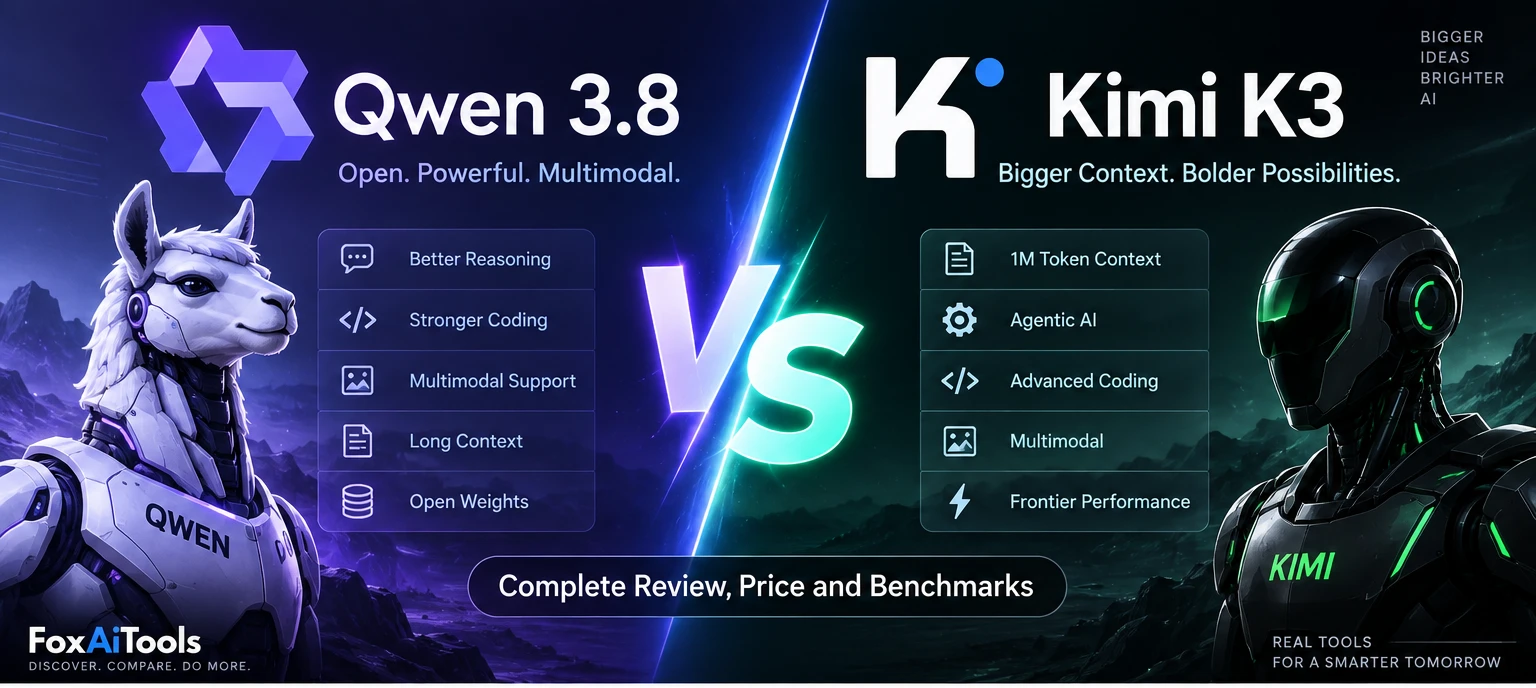
Which is Better Qwen 3.8 vs Kimi K3? Complete Review, Price and Benchmarks
The Qwen 3.8 vs Kimi K3 comparison is more complicated than simply asking which model has the higher benchmark score. Both are large multimodal reasoning models built for coding, research and agentic workloads, but they target different deployment scenarios.
Qwen's lineup now includes the compact Qwen3.8-27B as well as the much larger Qwen3.8 Max family. Kimi K3, meanwhile, is a 2.8-trillion-parameter mixture-of-experts model with a 1-million-token context window and native multimodal capabilities.
For developers, the biggest differences come down to model size, context length, price, deployment flexibility and the type of workload being performed.
Also Check: AI 3D Model Generator
Qwen 3.8 vs Kimi K3 Overview
| Feature | Qwen3.8-27B | Qwen3.8 Max | Kimi K3 |
| Total parameters | 27B | 2.4T | 2.8T |
| Architecture | Dense | MoE | MoE |
| Context | 262K native, up to 1M | 1M | 1.048M |
| Vision | Yes | Yes | Yes |
| Video | Yes | Yes | Yes |
| Reasoning | Yes, configurable | Yes | Yes |
| Open weights | Yes | Depends on variant | Yes |
| Input price* | $0.50/M | $2/M | $2/M |
| Output price* | $3/M | $6/M | $11.20/M |
| Best suited to | Efficient deployment | High-end general/agentic work | Long-horizon agentic work |
*API pricing can vary by provider and model snapshot. The prices above reflect current OpenRouter listings for the compared models.
What is Qwen 3.8?
Qwen3.8 is the latest generation of Qwen open models. The Qwen3.8-27B version is particularly interesting because it brings multimodal and agentic capabilities to a considerably smaller dense model.
According to Qwen's model documentation, Qwen3.8-27B has 27 billion parameters, native vision-language capabilities and a 262,144-token context window that can be extended to 1 million tokens. It supports text, image and video understanding.
Qwen also provides controllable reasoning. Thinking is enabled by default, while developers can adjust reasoning effort between low, medium and xhigh. This makes the model easier to adapt to workloads where response quality and inference cost need to be balanced.
The larger Qwen3.8 Max takes a different approach. Qwen describes it as a flagship model with a 1-million-token context window and support for text, image and video input. It is positioned for complex reasoning, coding, document analysis and agentic workloads.
What is Kimi K3?
Kimi K3 is Moonshot AI's open-weight multimodal agentic model. Its headline specification is its 2.8 trillion total parameters with approximately 104 billion activated parameters. It uses a mixture-of-experts architecture with Kimi Delta Attention and Attention Residuals.
Kimi K3 supports a 1,048,576-token context window and handles text and images natively. Its model documentation also describes use cases involving long coding sessions, large repositories, terminal tools, research and other long-horizon agentic workflows.
One important difference for developers is that Kimi K3 always has thinking enabled. The model supports configurable reasoning effort, including low, high and max settings, but its reasoning architecture is more tightly integrated into the model's normal workflow.
Qwen 3.8 27B vs Kimi K3 - Model Size
This is one of the biggest differences in the comparison. Qwen3.8-27B is a 27-billion-parameter dense model, meaning its full parameter set is used during inference.
Kimi K3 is a 2.8-trillion-parameter MoE model, but only around 104 billion parameters are activated per token.
That doesn't mean Kimi K3 is automatically 100 times more capable. MoE models don't work that way. Total parameters describe the capacity of the model, while activated parameters give a better indication of the computation used for an individual token.
For someone running an AI model locally, however, this distinction matters considerably. Qwen3.8-27B is a much more realistic model to experiment with on powerful consumer hardware, especially using quantized versions.
Qwen's official model repository provides compatibility with Transformers, vLLM, SGLang, TokenSpeed and local deployment tools, with quantizations available for applications such as llama.cpp, Ollama and LM Studio.
Qwen 3.8 vs Kimi K3 Benchmarks
Benchmark comparisons need some caution because results depend on the exact model variant, reasoning setting, harness and benchmark version.

For example, Qwen reports 73.0 on Terminal Bench 2.1, 61.7 on SWE-bench Pro and 90.3 on LiveCodeBench v6 for Qwen3.8-27B in its own evaluation table. It also reports 84.3 on OSWorld-Verified and 64.8 on WebArena-Verified.
Kimi K3's published evaluation reports 88.3 on Terminal-Bench 2.1, 67.5 on DeepSWE, 81.2 on FrontierSWE and 84.8 on OSWorld-Verified using its specified maximum-reasoning configuration.
These numbers should not be treated as a perfectly controlled head-to-head test because the two model teams use different evaluation setups.
An independent Artificial Analysis comparison currently reports an Intelligence Index of 34 for Qwen3.8-27B and 44 for Kimi K3, while also showing Qwen3.8-27B with higher measured output speed and substantially lower token pricing in that comparison.
The useful takeaway is not that one benchmark settles the argument. Instead:
- Kimi K3 is positioned as the larger frontier-class agentic model.
- Qwen3.8-27B offers a much smaller deployment footprint.
- Qwen3.8-27B can deliver strong coding and multimodal results at substantially lower inference cost.
- Benchmark results vary significantly according to task and evaluation configuration.
Qwen 3.8 Max vs Kimi K3
The comparison changes when you move from Qwen3.8-27B to Qwen3.8 Max. Qwen3.8 Max is much closer to Kimi K3 in intended workload. OpenRouter currently lists both with approximately 1 million tokens of context. Its current listing shows Qwen3.8 Max (0902) at $2 per million input tokens and $6 per million output tokens, compared with Kimi K3 at $2 input and $11.20 output per million tokens on the same platform.
That makes the output-token difference particularly relevant for coding agents and research systems that generate large amounts of text, tool calls or code.
In other words, the question isn't simply:
Which model is smarter?
A better question is: Which model gives the required capability at the cost and deployment model that fits the workload? For high-volume API usage, the output-price difference can become significant.
Qwen 3.8 vs Kimi K3 price
Pricing changes over time and can differ between direct APIs and aggregators, so developers should check the provider immediately before deployment.
At the time of this comparison, OpenRouter lists:
| Model | Input / 1M tokens | Output / 1M tokens |
| Qwen3.8-27B | $0.50 | $3 |
| Qwen3.8 Max (0902) | $2 | $6 |
| Kimi K3 | $2 | $11.20 |
The Qwen3.8-27B price difference is substantial enough to change how a developer designs an application.
For example, a system could use a smaller model for classification, extraction, simple coding assistance or preliminary analysis and reserve a larger model for difficult reasoning tasks.
That type of routing can matter more to an application's final cost than simply choosing whichever model has the highest benchmark score.

Which Model is Better for Coding?
Both models are designed for serious coding workloads. Qwen3.8-27B's official results include 61.7 on SWE-bench Pro, 42.2 on DeepSWE 1.1 and 79.0 on QwenSWEBench.
Kimi K3's published results include 67.5 on DeepSWE, 81.2 on FrontierSWE and 88.3 on Terminal-Bench 2.1.
For large repositories and long-running coding agents, Kimi K3's 1-million-token context and agent-focused design are particularly relevant.
For developers who want a smaller model that can be deployed and experimented with more easily, Qwen3.8-27B is the more practical architecture.
Qwen's model card also supports deployment through vLLM and SGLang and provides quantization options for local applications.
Which is Better for Long-Context Tasks?
Here the distinction is straightforward. Kimi K3 provides a 1,048,576-token context window. Qwen3.8-27B has a 262,144-token native context, although Qwen states that it can be extended to 1 million tokens. Qwen3.8 Max is designed around a 1-million-token context window.
For very large repositories, lengthy research material and long-running agent sessions, the larger-context models have an obvious practical advantage.
But context capacity isn't the same thing as context quality. A larger window doesn't guarantee that a model will make better use of every piece of information inside it.
Also Check the comparison video of these tools to get more clarifications.
Which Model is Better for Multimodal AI?
Both families support multimodal workloads, but their documentation highlights slightly different strengths.
Qwen3.8-27B supports image and video understanding, including documents, diagrams and long videos. Qwen reports strong results across OSWorld, visual reasoning, document intelligence and other multimodal evaluations.
Kimi K3 supports text and image inputs natively and has a 1-million-token context. Its published benchmark table includes results for OmniDocBench, Video-MME, MMVU, MathVision and other vision-oriented evaluations.
For applications that need to process visual information alongside long textual context, both are capable options. The actual choice should be based on the specific modality and workflow rather than the word "multimodal" alone.
Qwen 3.8 vs Kimi K3 - Pros and Cons
Qwen3.8-27B
Pros
- Much smaller 27B dense architecture
- Apache 2.0 licence
- Native image and video understanding
- Configurable reasoning effort
- Strong coding and agentic benchmark results
- Easier to experiment with locally
- Lower API cost
Cons
- Smaller native context than Kimi K3
- Not intended to match the raw scale of frontier MoE models
- Some long-horizon workloads may benefit from a larger model
Qwen3.8 Max
Pros
- 1-million-token context
- Multimodal input
- Designed for coding and agentic workflows
- Lower output price than Kimi K3 on the current OpenRouter comparison
- Strong long-document and tool-use capabilities
Cons
- Much larger model than Qwen3.8-27B
- More expensive to operate than the 27B version
- Local deployment is substantially more demanding
Kimi K3
Pros
- 2.8T total parameters with 104B activated
- 1.048M-token context
- Native multimodal architecture
- Strong long-horizon coding orientation
- Open weights
- Designed for agentic workflows
- Strong results across coding, research and tool-use benchmarks
Cons
- Much more demanding model to deploy locally
- Higher output-token cost than Qwen3.8 Max on the current OpenRouter listing
- Always-on thinking can make it less suitable for very simple, high-volume responses
So, which should you choose?
The answer depends heavily on what you're building.
Choose Qwen3.8-27B when:
- You want a relatively compact open model.
- API cost is important.
- You need image and video understanding.
- You want to experiment with local deployment.
- You need strong coding without operating a multi-trillion-parameter model.
- You want adjustable reasoning effort.
Choose Qwen3.8 Max when:
- You want Qwen's larger flagship architecture.
- You need approximately 1M-token context.
- You're building coding or research agents.
- Output-token cost matters.
- You want a high-end multimodal model through an API.
Choose Kimi K3 when:
- Long-horizon agentic coding is central to your workload.
- A 1M-token context is important.
- You're working with large repositories or extended tool workflows.
- You want Kimi's open-weight 2.8T MoE architecture.
- You are prepared for the infrastructure requirements of a much larger model.
The Biggest Mistake When Comparing Qwen 3.8 and Kimi K3
A common mistake is comparing Qwen3.8-27B directly with Kimi K3 and then treating the result as a comparison of the entire Qwen3.8 family.

They are very different classes of models. Qwen3.8-27B is a compact dense model. Qwen3.8 Max is a flagship-scale model. Kimi K3 sits in the same broad high-end category as Qwen3.8 Max rather than the 27B model.
That distinction makes a major difference when interpreting benchmarks, pricing and hardware requirements.
Another mistake is looking at a single benchmark and declaring a universal winner. Coding, mathematics, multimodal reasoning, research, browser use and long-context tasks measure different abilities.
Final Words
The Qwen 3.8 vs Kimi K3 comparison doesn't have one answer for every user. Qwen3.8-27B is compelling when cost, deployment flexibility and model size matter. Qwen3.8 Max moves into the high-end model category, with a 1-million-token context and pricing that is currently lower than Kimi K3's output rate on OpenRouter.
Kimi K3 brings a much larger 2.8T-parameter MoE architecture, a 1.048M-token context and a strong focus on long-horizon agentic coding and knowledge work.
For developers, the practical decision should therefore be based on workload, context requirements, deployment resources and token economics, not on a single benchmark number. If you are building a cost-sensitive application or experimenting locally, Qwen3.8-27B deserves consideration. For demanding long-context agentic workloads, the comparison becomes much closer between Qwen3.8 Max and Kimi K3.
Frequently Asked Questions
1. Is Qwen 3.8 better than Kimi K3?
There is no universal answer. Qwen3.8 includes both a 27B compact model and larger flagship variants, while Kimi K3 is a 2.8T MoE model. Their relative performance depends on the workload and benchmark.
2. Is Qwen 3.8 27B cheaper than Kimi K3?
Yes, based on the current OpenRouter comparison. Qwen3.8-27B is listed at $0.50 per million input tokens and $3 per million output tokens, while Kimi K3 is listed at $2 and $11.20 respectively.
3. Does Qwen3.8-27B support images and video?
Yes. Qwen describes Qwen3.8-27B as a native vision-language model supporting image and video understanding.
4. Does Kimi K3 have a 1 million token context window?
Yes. Kimi K3's documented context length is 1,048,576 tokens.
5. Which is better for coding, Qwen 3.8 or Kimi K3?
Both are designed for coding. Kimi K3's published evaluations show strong results on agentic coding and terminal benchmarks, while Qwen3.8-27B also reports strong results on SWE-bench Pro, Terminal Bench and other coding evaluations. The exact choice depends on the coding workload, model size and cost constraints.
6. Can Qwen3.8-27B run locally?
Yes. Qwen provides deployment instructions for Transformers, vLLM and SGLang and points users toward quantized versions for tools such as Ollama and LM Studio. Actual hardware requirements depend heavily on quantisation and serving configuration.
7. Is Kimi K3 open source?
Kimi K3 is released with open model weights under the Kimi K3 License. Its official model documentation describes it as an open-weight model.
8. Which has the larger context window, Qwen3.8 or Kimi K3?
Kimi K3 has a 1,048,576-token context. Qwen3.8-27B has a 262,144-token native context that Qwen says can be extended to 1 million tokens, while Qwen3.8 Max provides a 1-million-token context.
Karthikeyan Selvaraj
Founder & Chief EditorKarthikeyan Selvaraj is the Founder and Chief Editor of FoxAITools. With over 8+ years of tech and software engineering experience, he personally tests, evaluates, and reviews cutting-edge AI software, SaaS tools, and machine learning models.
View Full Author Profile & Published Articles →